 Share on LinkedIn
 Share on X
Key Results
0%
more content unlocked by replacing keywords with IAS Context Control
0%
of suitable Reuters articles blocked by common keywords alone
The Challenge: When Keywords Fail the Context Test
The fundamental flaw with keyword blocking is that technology shouldn’t just read a page; it should understand it. Keywords lack nuance. They see a string of text but can’t recognize the story being told.
High-quality, premium news inventory is already a finite resource. When advertisers layer standard suitability settings on top of broad keyword blocklists, that inventory shrinks from a subset to a mere fraction. Brands then find themselves vying for the same tiny sliver of so-called “safe” content, driving up costs and limiting reach.
On the Reuters Lifestyle subdomain alone, 13.4% of ad impressions classified as safe against negative pop culture still contained an identified keyword that likely would have caused a failure. Whether it’s a report on a movie about a “dangerous” dinosaur or a business update about an “insider” promotion, keywords consistently mistake safe vocabulary for brand risk, resulting in unintended consequences for both the brand and the publisher.
The Approach
To solve this, Reuters utilized IAS’s Context Control solution built on semantic intelligence. It doesn’t just check for words – it deeply understands true meaning, sentiment, and intent.
Unlike a keyword list, Context Control understands:
- Word relationships, industry nuance, and context across categories, tuned specifically for advertising;
- Semantic nuances, like distinguishing “Jaguar” the animal from the car brand in milliseconds;
- Emotional and sentiment signals by pinpointing tone including love, fear, outrage to assess content suitability more precisely;
- Entity recognition, meaning it can detect people, places, and brands to match advertiser relevance.
In the Reuters study, IAS measured the main domain against 12 industry-standard brand safety segments at a medium risk threshold. This allowed the team to identify articles that were safe and suitable but contained “problematic” keywords that are essential to news but often found on blocklists.
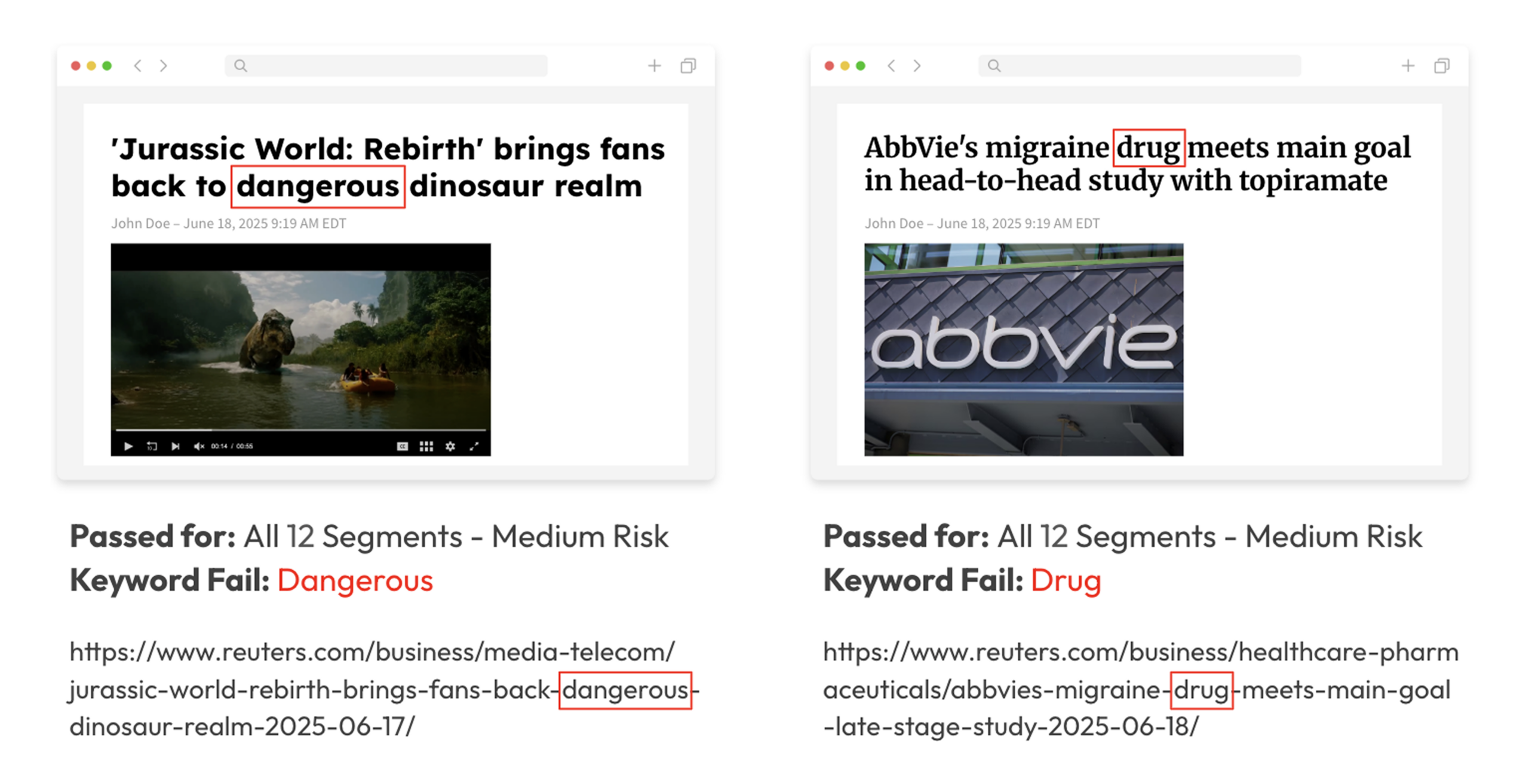
Based on the examples above, keyword lists would likely have blocked the content due to the word “dangerous” in the article on the left and “drug” in the article on the right. This is where nuance is needed — the article on the left is referring to a beloved movie, and the article on the right is about a medical breakthrough. No matter which way you cut it, this is not unsafe content.
The Results
When advertisers trade keywords for context, they protect their brand and expand their reach into premium environments.
By removing just seven top-populating keywords and replacing them with IAS Context Control segments, Reuters found that blocked content could be reduced by an estimated 58% across their premium news inventory.
This isn’t just about reclaiming lost impressions; it’s about gaining a competitive edge and supporting the publishers that provide high-quality journalism. When advertisers use context-based solutions, they move away from the sledgehammer and toward a strategy that values the environment as much as the audience.
News is safe, suitable and effective. And with the right technology, news provides the premium scale that brands need to grow.
Ready to reclaim your reach without sacrificing suitability? Talk to an IAS rep to learn how Context Control can modernize your media strategy.