 Share on LinkedIn
 Share on X
Overall, media quality improved in 2025, according to Integral Ad Science’s (IAS) 21st Edition Media Quality Report (MQR). But regional trends told a more nuanced story.
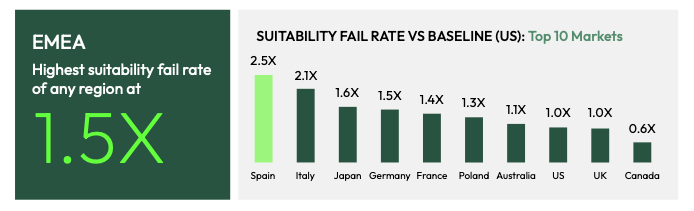
EMEA recorded the highest brand suitability fail rate of any region—1.5X the U.S. baseline (indexed at 1.0). Spain stood out at 2.5X the baseline, underscoring how widely suitability risk can vary across European markets.
Part of that variation stems from the region’s complexity. Multiple languages, diverse cultural contexts, and high volumes of digital content make accurate brand suitability classification more challenging than in many other markets.
For brands investing across Europe, those regional differences make a one-size-fits-all global approach increasingly difficult to justify.
What Brand Suitability Actually Measures
Brand suitability is often confused with brand safety, but the two serve different purposes.
Brand safety focuses on preventing ads from appearing alongside content that poses clear reputational risks, such as graphic violence or illegal activity. Brand suitability is broader. It allows advertisers to define what types of content align with their own brand standards, whether that’s gambling, alcohol, offensive language, hate speech, violence, or other sensitive topics.
A suitability fail occurs when an impression falls outside those settings. Higher fail rates suggest that more media spend is reaching environments that don’t match an advertiser’s preferences.
Within EMEA, the differences between markets are striking.
Spain recorded the highest suitability fail rate among the report’s top ten global markets at 2.5X the North American baseline. Germany reached 1.5X, France 1.4X, while the U.K. remained in line with North America at 1.0X.
Those aren’t small fluctuations. They show how much suitability risk can vary within a single region.
Why EMEA Is More Difficult to Classify
One of the biggest challenges comes down to language.
Much of today’s programmatic infrastructure was originally developed around English-language content. While suitability technology has evolved considerably, classifying content accurately across multiple languages is still far more demanding.
Campaigns running across Spain, Germany, France, Italy, Poland, and the U.K. encounter different vocabularies, slang, political references, and cultural nuances. The same word or phrase can carry very different meanings depending on context, making automated classification more difficult.
When classification becomes less accurate, advertisers face two problems. Unsuitable content may not be identified, while suitable inventory can be unnecessarily excluded. Either way, campaign performance suffers through wasted spend, reduced reach, or both.
Spain’s elevated fail rate is a good example of how those challenges can compound. High volumes of content combined with multilingual classification create an environment where maintaining consistent suitability standards becomes considerably more difficult.
Why Suitability Affects Performance
Brand suitability isn’t only about protecting reputation; it also influences campaign performance.
Ads placed in environments that don’t align with a brand often generate weaker engagement, lower recall, and less efficient conversions. Suitability therefore becomes part of media optimization rather than just an exercise in compliance.
IAS has consistently found that advertisers using proactive pre-bid suitability controls reduce unsuitable impressions before media is purchased rather than filtering them afterward. In one case study, a U.S. retailer reduced suitability fail rates by 65% over two months while doubling return on investment from its technology spend.
The same principle applies in EMEA, although the region’s linguistic and cultural complexity means advertisers often need more localized approaches than global settings alone can provide.
Turning Regional Complexity into an Advantage
EMEA presents challenges, but it also offers opportunities for advertisers willing to adapt.
Brands that tailor suitability controls to individual markets are generally better positioned to reduce wasted spend while maintaining broader reach. Relying on identical settings across every country may simplify campaign management, but it can also overlook meaningful differences in language, content, and risk.
The 2025 Media Quality Report reinforces that point. While media quality improved globally, progress hasn’t been uniform. EMEA continues to present unique suitability challenges that require market-level thinking rather than broad regional assumptions.
As advertisers optimize campaigns for 2026 and begin planning for 2027, success is likely to depend less on global averages and more on understanding the characteristics of the markets where campaigns actually run.
Unlock Actionable Insights for 2026
Explore the full 2025 Media Quality Report to see how media quality varies across EMEA, and discover strategies for improving campaign performance with localized, data-driven optimization.